From Link Lists to Hypertext: A Short History of the Hyperlink
The history of the hyperlink traces how linked documents changed reading, from Ted Nelson’s hypertext vision to clickable links on the web.
The most common mistake in telling the history of the hyperlink is to treat it as a single invention that suddenly connected the world’s documents. The history of the hyperlink is more layered: people imagined linked texts before the web, and the web made those links practical across networked documents. That distinction matters because a link is both a technical connection and a choice about how a reader moves.
What came before the web’s clickable links?
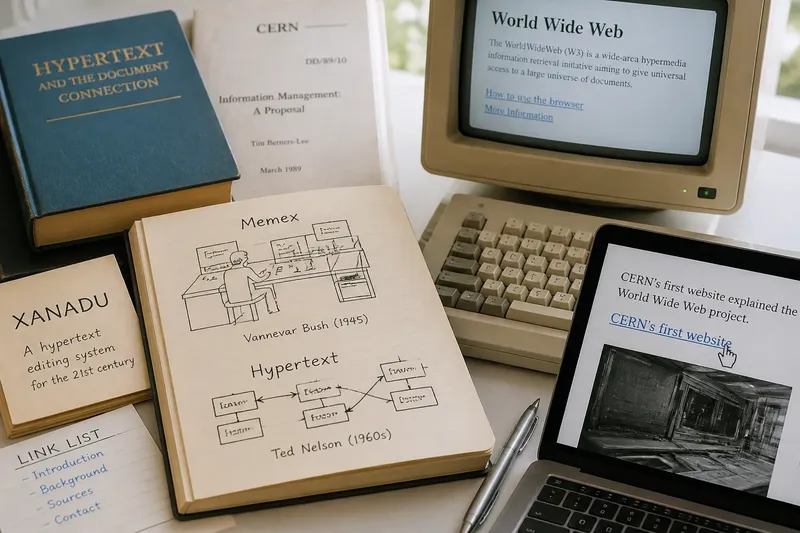
Long before web pages, readers encountered cross-references in footnotes, indexes, and bibliographies. These devices pointed elsewhere, but the reader had to locate the destination by hand. In the twentieth century, information scientist Vannevar Bush described a hypothetical device called the Memex in his 1945 essay “As We May Think.” It would let a user create associative trails through stored materials. The Memex was a proposal, not a working online system, but it gave a vivid account of connected reading.
In the 1960s, computer scientist Ted Nelson developed the term “hypertext” for text organized to allow links between documents or passages. His project Xanadu pursued a more ambitious vision of connected writing and attribution. It did not become the web, but it helped name the broader idea: a document need not be read only in a fixed sequence.
These antecedents were not interchangeable with a modern hyperlink. Bush imagined a personal information machine; Nelson explored a system for linked documents. Both help explain why the web’s link was part of a longer history rather than an isolated flash of invention.
How did the web turn that idea into a working system?
At CERN, Tim Berners-Lee proposed the World Wide Web in 1989 as a way to connect information across computers. The early web combined several elements: addresses for resources, a protocol for requesting them, and a markup language for documents. HTML links could connect one document to another using an address, so a reader could select marked text and move to the destination.
The first website, hosted at CERN, explained the World Wide Web project and how to use it. In 1993, CERN made the web’s underlying technology available on a royalty-free basis. That decision helped others build servers, browsers, and pages that could participate in the same system. These are concrete milestones, but they did not mean every earlier hypertext idea had simply been carried into the web. The web favored a comparatively simple, decentralized structure of documents connected by addresses.
A directory and an embedded link offered different kinds of movement. A directory presented a set of destinations for the reader to choose from. An embedded link attached a route to words or an image within a document. The link could now sit exactly where a reader encountered a reference, rather than only in a separate list.
That change made reading less strictly linear. It also gave the author or page designer influence over which routes appeared at a given point. A link can invite exploration, provide a source, or send a reader away from the page; its placement shapes the path even when the destination remains open-ended.
Why did links become part of the web’s structure?
Links did more than save readers from typing addresses. They let documents refer to one another without being stored in one central collection. A page could point to a separate page, a file, or a named location within a document. The web’s address system made those references actionable across computers, while HTML supplied a familiar way to mark them in text.
The result was a network whose structure was partly made by its authors. A bibliography can arrange sources in a list; a web page can connect each reference directly to a destination. Readers still choose which route to take, but publishers and page authors determine which routes are visible and how they are described.
Say you encounter a historical article with a link on the words “CERN’s first website.” You select it and arrive at a preserved page describing the web project. The link has changed the next action from searching for a title to opening a particular destination; the preserved page, in turn, supplies evidence about what the early web was meant to do. The route is useful precisely because its destination can be examined.
What changed as the web became easier to use?
Early web pages could contain lists of links as well as links embedded in sentences. As browsers and web publishing spread, links became ordinary parts of navigation: menus, highlighted words, image maps, and buttons all offered ways to move. The basic action remained recognizable, but the visual cue did not always look like underlined text.
That variety made links more flexible and less self-explanatory. A blue underlined phrase often signals a link; a button may look like an action; an image can conceal a destination behind its surface. Interface design now helps determine whether readers can tell what is clickable and where it might lead. The history of the hyperlink is therefore also a history of changing expectations about how a page should guide attention.
Links can also point to resources that later move or disappear. A web address is a route to a location, not a permanent guarantee that the material will remain there. Archives and preserved copies can help maintain access, but they may differ from the live page or omit interactive features. That vulnerability is one reason digital history depends on preserving not just ideas, but the documents and systems that carried them.
What questions do readers ask about hyperlink history?
Who coined the term hypertext?
Ted Nelson developed the term “hypertext” in the 1960s for text connected through links. His work explored a broad vision of linked documents, distinct from the particular architecture later used by the web.
When was the World Wide Web proposed?
Tim Berners-Lee proposed the World Wide Web at CERN in 1989. The early web joined documents through addresses, a transfer protocol, and HTML, making linked pages usable across networked computers.
Was the web the first hypertext system?
No. The web drew on a longer history of ideas about connected information, including Bush’s Memex proposal and Nelson’s hypertext work. Its distinctive contribution was a practical system for linking documents across the internet.
Why do old web links sometimes fail?
A link depends on an address and on the continued availability of the resource at that address. Sites change, pages are removed, and archives may preserve only part of an original page.
What does the link’s history leave us with?
The hyperlink joined an old reading habit—following references—with a new kind of direct movement between networked documents. Bush’s associative trails and Nelson’s hypertext helped articulate the possibilities; Berners-Lee’s web made a particular form of linking broadly usable. Those milestones explain the lineage without reducing it to one inventor or one moment.
For a careful reader, the most useful historical distinction is between the idea of connected reading and the web’s specific implementation. A link can be a reference, a navigation control, or a route chosen by a page’s author. Knowing how those roles developed makes it easier to see that the web’s structure is not neutral: every link places one possible next move within reach.